



FUJIFILM Business Innovation has developed new post-processing technologies coordinated with print job output, including high-speed, high-accuracy saddle-staple finishing, two-sided trim, and creasing, thus delivering enhanced post-processing functionality as well as an expanded range of compatible paper and improved productivity. Also, because we have standardized the interfaces between all units (including the finishing units and the main unit,) and optimized their paper timing, we were able to divide the various post-processing functions into separate modules, giving customers the freedom to choose the functions they need or to add new functions later. In addition, we have moved the inserter function to the first stage of post-processing, allowing special paper types, or pre-printed pages to be inserted, as covers or inserts with any of the subsequent post-processing functions.
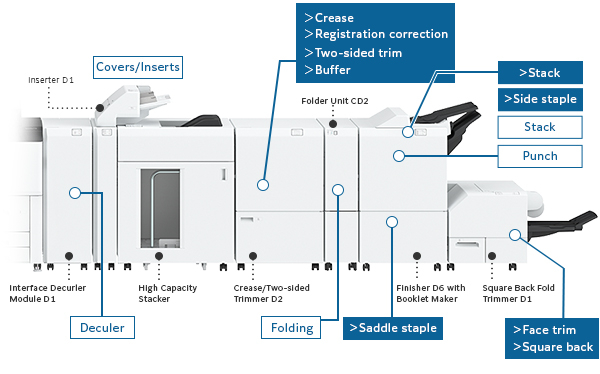
This function adds creases in advance to pamphlet covers, cards, etc. where they are to be folded, helping to reduce the occurrence of image cracking and improve the quality of the printed documents. Adding creases for different folding directions (i.e., mountain and valley folds) is done by changing the direction of the two creasing blades accordingly. As many as five creases can be added to a single sheet of paper, and the amount of force used to create the creases can be adjusted depending on the thickness of the paper. A wide variety of folds, including accordion folds, can be achieved with this function.
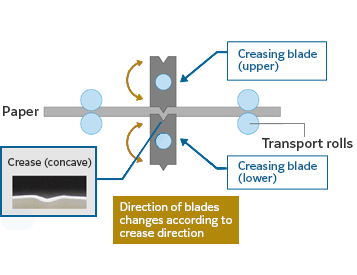
Image of creasing(for mountain fold)
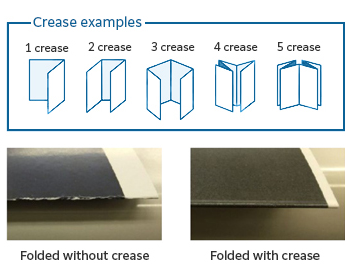
Image cracking(comparison of folding done without crease and with crease)
In keeping with the diversification of print jobs, FUJIFILM Business Innovation has developed registration correction technology using a roll-swing method to allow for compatibility with heavyweight paper. Registration correction is performed as follows: first, the skew amount (tilt) of a transported sheet of paper is detected by a sensor, and before the paper arrives at the swing roll, the roll is tilted based on the detected skew amount. Then, just after the lead edge of the paper passes through the tilted swing roll, the tilt of the roll is returned to normal, correcting the skew of the paper.
In the newly developed two-sided trim function (used to trim the top and bottom of the paper), adjustment of the trimming locations is done automatically by detecting the positions of the sides of each page using a contact image sensor and moving the cutter units to the detected positions, thus achieving improved cutting precision and high-quality post-processing output. In addition, we have adopted a round-bladed cutter to allow for compatibility with paper types ranging from light weight paper (52 gsm) to heavy weight paper (350 gsm), and we have allowed the two cutter units to move independently of one another in order to accommodate paper widths (before cutting) ranging from 196 to 300.2 mm. The dimensions for cutting location and paper width after cutting can be adjusted in increments of 0.1 mm. Also, because the strips of trimming waste are neatly aligned in the dust box with no empty pockets, we were able to reduce the size of the dust box, conserving space. Furthermore, the dust box can be briefly opened and emptied even while a job is running, eliminating the need to stop processing and preventing productivity losses.

Sample image of two-sided trim
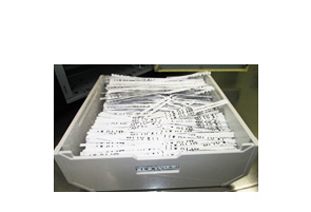
Trimming waste stored in dust box
Because paper for a subsequent job cannot be transported to the Finisher while saddle stapling / folding for the preceding job is still in progress, in the case of previous models, the subsequent job had to await processing, causing a loss of productivity. To address this problem, the first two sheets of the subsequent job are now held in a buffer path in the Crease/Two-sided Trimmer unit while the preceding job is being processed in the Finisher, and the two sheets are simultaneously transported to the Finisher when it becomes possible to do so. This buffer greatly reduces the total time required for post-processing, improving productivity.
Many different sizes and types of paper are output to the paper output tray of the Finisher. In the case of lightweight paper or lightweight coated paper, depending on the output angle of the paper and the angle of the tray, poor stacking may occur due to friction between the paper and tray or other sheets of paper. To address this, we have made it possible to switch the angle of the output tray when using lightweight paper or lightweight coated paper, reducing the paper's frictional resistance. Furthermore, the design of the tray makes it easy for the user to switch between angles while also preventing the angle from changing unintentionally due to the weight of the paper in the tray, etc.
The paper compiling area has a two tampers, one on each side, that move independently, allowing the pages to be compiled in the same position in which they are to be output. Corner stapling is done by holding the entire stack of pages between the two tampers and moving it to the stapler all at once, which minimizes the necessary movement of individual sheets of paper. This improves the Finisher's capability of handling curled paper, increases the speed of post-processing, and enables compilation of smaller paper sizes, thus increasing the range of compatible paper types. To improve productivity, we have added a buffer immediately before the paper compiling mechanism in which two sheets can be stored temporarily. Reducing transport resistance and optimizing the driving control within the buffer path prevents the multiple overlaid sheets of paper from shifting out of position and aligns them as they are being transported.
To reduce the noise caused by operation of the stapler in the Finisher, we have optimized the control of the motor's current value and used controlled the motor speed using multistage control according to the paper type and number of sheets each time stapling is done. This enables the minimum force necessary to be used when stapling, reducing noise and creating a more pleasant environment.
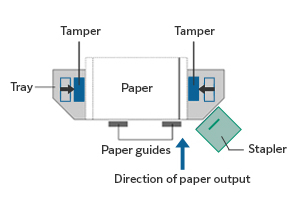
Configuration of paper compilation area
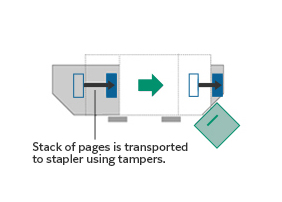
Paper compilation area during stapling
In the saddle staple finishing area, we have modified the placement of the stapler and folding rolls and extended the length of the tampers used to compile the paper, thus improving the accuracy of compilation for larger sizes of paper. Also, to deal with curling of the paper due environmental changes, etc. we have added a clamp mechanism to hold the paper in place and reduce the misalignment of the paper caused by bending, etc. Because the paper is secured in the correct position, folding accuracy is improved.
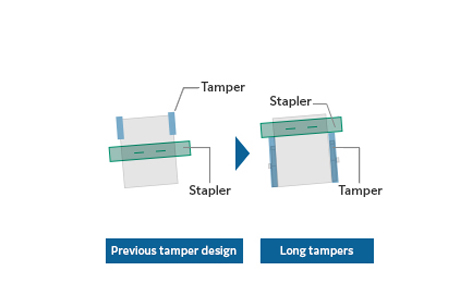
Configuration of long tampers
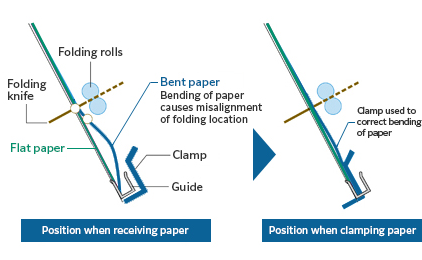
Image of clamp mechanism
In order to increase the number of pages that can be folded, the folding rolls have a configuration that allows them to swing outward toward both sides. In addition, the pressure of the folding rollers changes to the optimal pressure depending on the number of sheets of paper being folded, and the diameter of the folding rollers has also been optimized, making it possible to reduce the occurrence of wrinkles in the paper whether folding booklets with a few pages or many pages.
In the cutter where face trimming is performed, we have improved the design of the part used to secure the booklet in place and optimized the amount of pressure used in order to reduce shifting of the booklet during trimming. This makes it possible to perform face trimming in the correct location regardless of the number of sheets in the booklet, delivering high-quality finished output.
As the number of pages in a saddle-stapled booklet increases, bulging of the spine occurs. Square fold finishing creates a flat spine by securing the booklet between two clamps, then using a flattening roller to apply pressure to the booklet's spine. This process reduces the bulging of the spine for high-quality finished output.
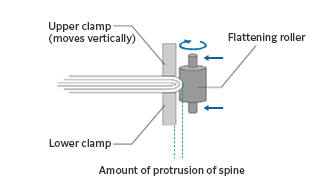
Configuration of square fold
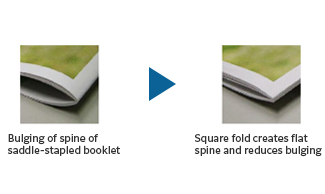
Image of square fold output