



FUJIFILM Business Innovation's multifunction devices perform printing by using the technology called "xerography," first commercialized by Xerox Corporation.
In xerography, printing is performed by five processes (1. charging, 2, exposure, 3. development, 4. transfer, 5. fusing) by using optical semiconductors called photoreceptors.
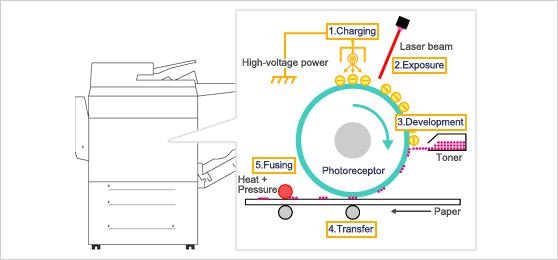
Let's take a look at the five printing processes by xerography, taking a simple document image as an example.
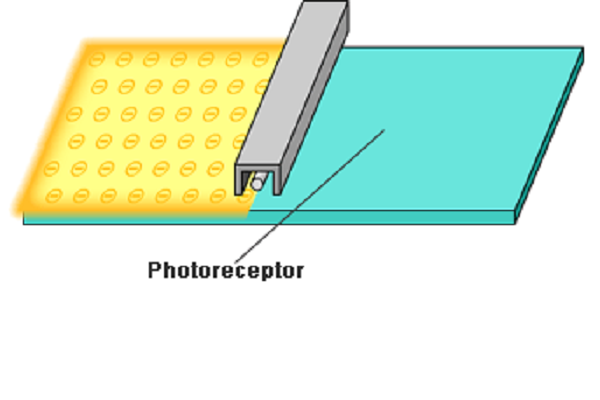
The entire photoreceptor* is negatively charged by delivering negatively-charged ions using a wire with high-voltage.
- * a semiconductor which generate positive charges when exposed to light.Xerography uses this characteristic to perform printing.The above photoreceptor in plate form is provided for the purpose of illustration.Actual color multifunction machines use cylindrical photoreceptors
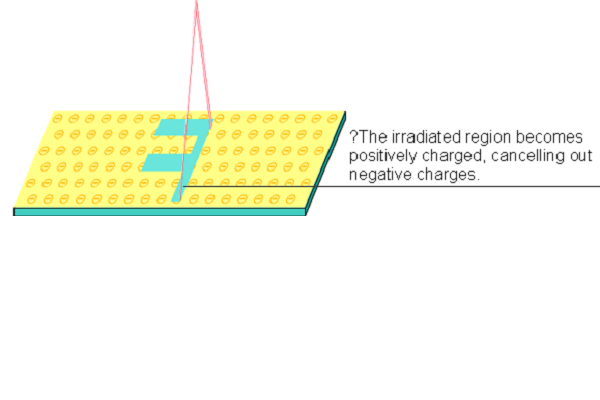
A laser beam according to the image of the original document is irradiated onto the negatively-charged photoreceptor. The irradiated region of the photoreceptor generates positive charges, and negative charges were cancelled out.
A mirror image of the original document image provided by negative charges is formed on the photoreceptor.
Since toner immediately after transfer is just put on paper, it soon comes off.Accordingly, toner is fixed to prevent it from coming off by applying heat and pressure with a fixing roll to melt toner into paper.
In such a way, toner is permanently bonded on paper and copying is completed.
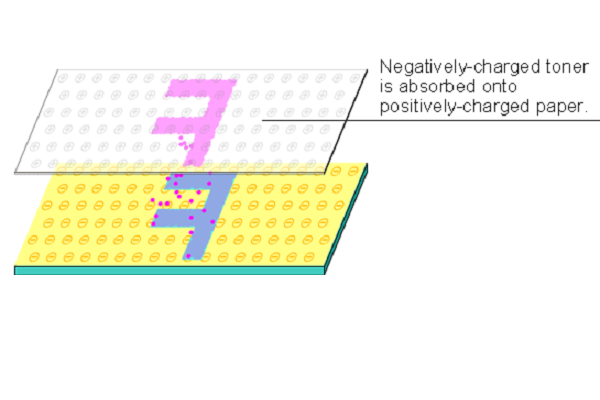
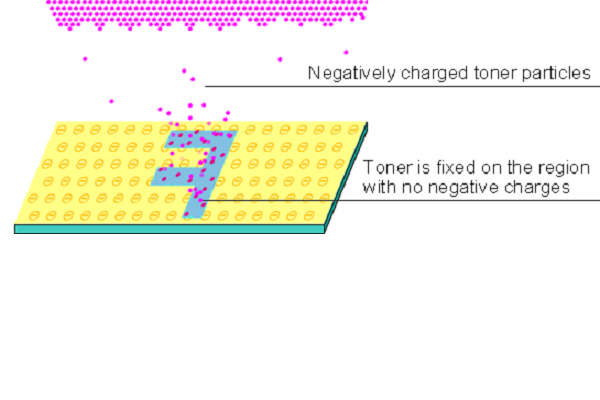
Positively-charged paper is brought close to the photoreceptor. By using the characteristic that positive charges attract negative charges, negatively-charged toner is absorbed onto paper.
The image of the original document formed by toner is transferred onto paper.
- * Actual multifunction machines have a transfer roller to perform a transfer by exerting an electrical force from the backside of paper.
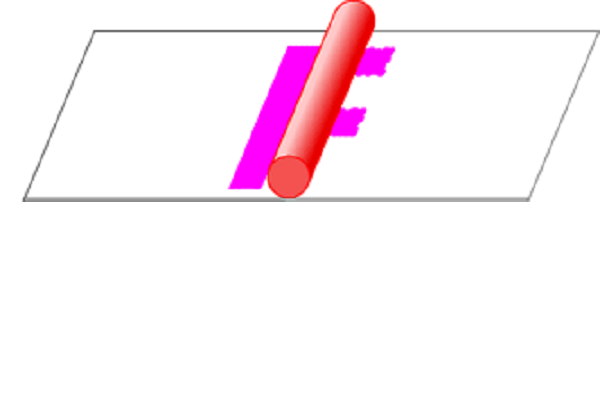
Since toner immediately after transfer is just put on paper, it soon comes off.Accordingly, toner is fixed to prevent it from coming off by applying heat and pressure with a fixing roll to melt toner into paper.
In such a way, toner is permanently bonded on paper and copying is completed.
Inner workings of color multifunction machine In a color multifunction device, four images which have been subjected to four color separation (yellow, magenta, cyan, black) are exposed and developed onto each of the four photoreceptors.
Four-color toner images developed in this way are transferred onto the transfer belt temporarily and then transferred onto paper by one operation.
Finally, fusing toner onto paper completes color printing.
- * Photoreceptors used in an actual multifunction device have the same color. However, they are painted in four toner colors used in development for the sake of clarity.