













In today’s business landscape, organisations are grappling with a multitude of technological challenges, including a shortage of IT talent, more stringent ESG regulations, and the accelerated progression of AI. Compounding these challenges are intrinsic practicalities – uncertainty about where to begin, difficulty in assessing return on investment, and the complexity of coordinating with multiple vendors. Many businesses are still struggling to build IT infrastructure and strengthen security.
One firm has emerged as a proactive problem solver in this space. By working closely with clients in diverse industries and of varying organisational scale, primarily in the Asia-Pacific (APAC) region, it has positioned itself in the forefront of digital transformation (DX). In this article, we take a close look at this company and examine the key success factors behind its effective business DX, which is the foundation of future growth.

Shiro Kikuchi: Corporate Vice President of FUJIFILM Business Innovation / Motoru Takizawa: General Manager, Marketing Business Solution Division of FUJIFILM Business Innovation
A One-Stop DX Partner
The company is FUJIFILM Business Innovation. More than a vendor or system integrator, this company is a one-stop DX partner. Kikuchi, who leads the company’s overseas business, explains, “To provide sustainable and comprehensive support for digital transformation, we’ve had to renew the traditional approach.” He continues, “Today, organisations face a wide spectrum of challenges. Because the level of DX maturity, business partnerships, and employee literacy differ from one corporation to another, the number of possible solutions and combinations thereof is virtually limitless.”
“What sets us apart,” Kikuchi adds, “is our extensive familiarity with a broad range of global solutions, both our own and those of other companies. This allows us to identify and deliver the optimal solution for each customer. This discernment is highly valued today – and is a key reason so many companies trust us, backed by our extensive experience in this field.”
We Don’t Sell Products – We Sell Solutions
“Introducing technologies or systems that don’t align with a company’s specific circumstances can be completely ineffective and, in some cases, may even hinder productivity,” says Takizawa, who is Marketing Manager of the Business Solutions Division at FUJIFILM Business Innovation and, along with Kikuchi, has implemented solutions at numerous companies. While the company does introduce new products, Takizawa emphasises that this is the means to reaching its goal – not the goal itself. “Our objective is to guide each client’s digital transformation toward the right solution.” To that end, he explains that their approach is to offer solutions in four phases:
FUJIFILM Business Innovation Solution Phases
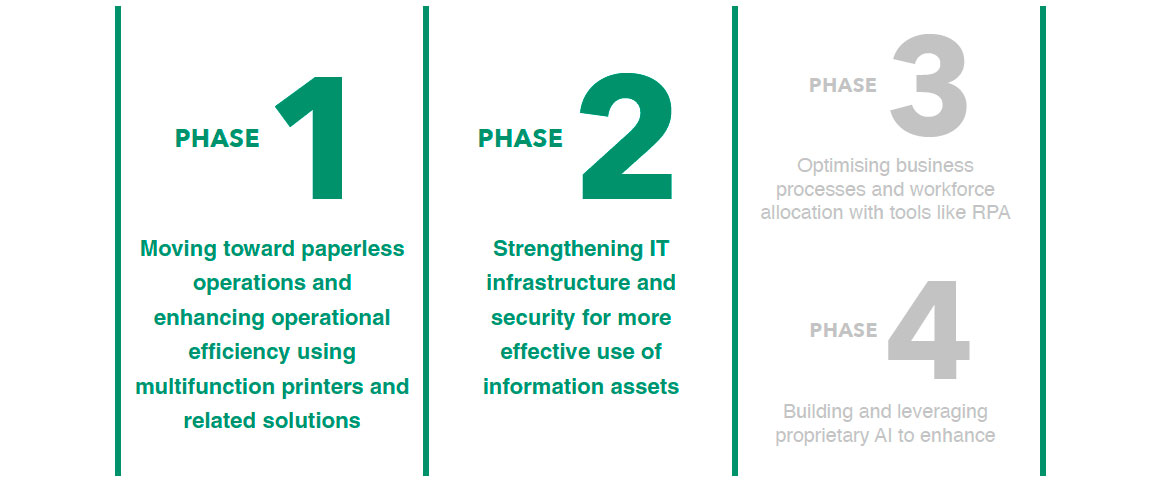
“Each of these phases takes time to implement. They require careful long-term planning, strategic decision-making, and the determination to see it through. That’s exactly what we offer.”
FUJIFILM Business Innovation stands out not only for its success in delivering immediate solutions but also for its support as a trusted long-term partner – leading digital transformation and assisting companies in their pursuit of growth.
Blurring the Boundaries Between Analog and Digital
What are the key initiatives in each of these phases? At the core of Phases 1 and 2 are next-generation Multifunction Printers (MFPs). “MFPs, which provide four basic functions – printing, scanning, copying, and faxing – have advanced significantly in recent years,” says Takizawa. “While they’re still often viewed as simple output devices, they are actually much more than that. They are critical information gateways that support data input for corporate digital transformation and IT solutions.”
To take digital transformation to the next level, companies need to digitise analogue information with speed, accuracy, and minimal resource consumption. In today’s business environment – where printers and fax machines are still very much in use – it is essential to establish a strong infrastructure at the outset. This infrastructure acts as a bridge between the analogue and the digital worlds and serves as the foundation for a more connected, efficient organisation.
Automation, Optimisation, and Environmental Responsibility
The MFP’s evolution is no longer just about achieving faster speeds or lower costs. Takizawa explains that the real game changer is business-process automation: “When scanning documents in the past, users had to manually set the destination and file name for each type of document. But by integrating documents received via MFP with AI-OCR and cloud services, users can execute appropriate processing.” For example, the system can automatically route invoices to the accounting department or send contracts to the legal department. Even complex instructions – like “locate the invoice number” or “extract the number and use it as the file name” – can now be executed entirely by the MFP itself.
Driving this shift is a clear business need: to improve operational efficiency. “In workplaces that handle large volumes of documents, manual input often creates bottlenecks. By removing that bottleneck, we enable employees to focus on higher-value tasks and core business activities.”
A New Value Axis:
Contributing to the Reduction of Environmental Impact
A key axis in the more recent evolution of MFPs is environmental consciousness – an important principle of corporate social responsibility and environmental initiatives, according to Kikuchi. “In recent years, reducing environmental impact has become a major focus in corporate activities across the APAC region,” he notes. As a hardware manufacturer, FUJIFILM Business Innovation is leveraging its expertise in physical chemistry – particularly in toner materials and thermal-control technologies – to support this shift. “Take electricity consumption, for example,” explains Takizawa. “Around 60 to 80 percent of the power used by MFPs goes into the heating process required to melt and fix toner during printing. To reduce power usage, we reconsidered the toner itself.” By developing toner particles that respond to lower and more precisely controlled heat, the company succeeded in both reducing energy consumption and enhancing print quality.
Advancements such as this are just the beginning. Other environmental innovations include a unique ”Staple-free stapling” system and the creation of a ”Resource circulation system” for collected used products. MFPs developed with energy-saving, reuse, and recycling-conscious designs are increasingly being recognized as an effective means for companies to advance their environmental initiatives.
Entrusting Advanced IT Infrastructure and Security to the Experts
Once companies have gone paperless and improved operational efficiency, what comes next? According to Kikuchi, “Once you’ve secured the information entry point, the next critical step is building the infrastructure needed to properly manage that information.” In this phase, the focus shifts to constructing and operating an advanced IT environment – without overburdening internal systems. A highly effective approach for this is managed IT services – end-to-end support for a company’s entire IT operation.
Experiencing rapid growth in recent years, these services offer outsourced support for everything from server operations, endpoint management, and network monitoring to help-desk functions, backup, and disaster recovery. FUJIFILM Business Innovation itself provides such solutions through its IT Expert Services, a comprehensive offering that even includes IT strategy development – which is typically difficult without having dedicated in-house IT professionals. The service is designed to provide one-stop support for IT operations, optimisation, and long-term strategic planning.
In the Asia-Pacific region, the company already manages over 3,000 servers and more than 90,000 devices. “We’re able to conduct our own internal digital transformation while maintaining stable IT operations and strengthening security,” says Kikuchi. “This also allows us to reassign internal talent to more strategic roles – an ideal approach in today’s labour-constrained environment.”
- * Service availability and details may vary by region. For further information, please contact us directly.
Hundreds of Experts – at a Reasonable Cost
For companies that have adopted this service, the impact on their IT departments has been significant. Where teams were once bogged down by troubleshooting and system maintenance, they can now shift their focus to higher-value initiatives – like exploring new technologies and advancing business digitisation. “IT Expert Services offers 24/7 system monitoring, and when a problem is detected or early warning received, we act immediately to prevent disruptions,” says Takizawa. “We also stay up to date with the latest security threats, thereby strengthening defence measures and minimising the risk of downtime. This fundamentally transforms the way IT personnel work.”
Kikuchi admits that even the best support loses value if the costs outweigh the benefits: “Expert support does come at a cost – but by delivering these services across a broad customer base, IT Expert Services is able to offer high-quality, specialised support at a reasonable price.”
Once the fundamental elements of corporate digital transformation are in place, what comes next? “After establishing a solid IT infrastructure, the next phase is about leveraging it strategically to transform business processes,” explains Kikuchi. “What’s needed at this stage is a comprehensive, company-wide approach. It involves using accumulated data to reimagine workflows and optimise how each employee works.”
NEXT [PHASE 3, 4]
In the second part of this article, we will take a close look at the specific DX solutions proposed by FUJIFILM Business Innovation to help organisations maximise their capabilities. From enhancing individual productivity and creating next-generation workspaces that blend the physical and the digital to redesigning core business processes – we will explore practical, actionable methods that are essential for successful digital transformation.