



TOKYO, September 30, 2026 FUJIFILM Corporation has demonstrated, through a collaborative research project with research groups from Osaka University, Okayama University, Kindai University, the Institute of Microbial Chemistry, and Kyushu University, that AI-AAM®, the core technology behind its proprietary AI drug design service drug2drugs®, is useful for designing novel bioactive compounds starting from known active compounds*1. In this study, AI-AAM® enabled the discovery of novel inhibitors targeting proteins involved in the virulence and antimicrobial resistance of pathogenic bacteria. The research results were published in The Journal of Antibiotics, an international academic journal in the field of antibiotic research, on September 30, 2026 (Japan time).
AI-AAM® is Fujifilm’s proprietary computational science technology that combines its unique Amino Acid Mapping (AAM) descriptor, which quantifies the binding affinity between the amino acids that constitute a target protein and a compound to predict the binding affinity between the protein and the compound, with Fujifilm’s proprietary AI technology*2 for designing novel compounds with stable chemical structures. AI-AAM®can identify and design new compounds based solely on the chemical structure of a known active compound, without the detailed structural analysis of the target protein that has conventionally been required.
As the global spread of antimicrobial-resistant bacteria continues to pose a major challenge, there is growing interest in developing infectious disease therapeutics with novel mechanisms of action that target pathways involved in bacterial virulence and antimicrobial resistance. In this collaborative research, AI-AAM® was used to search a virtual library of approximately 12 million compounds, starting from a natural organic compound known to inhibit histidine kinase, which plays a central role in signal transduction involved in bacterial virulence and antimicrobial resistance. As a result, the researchers identified 714 inhibitor candidates with chemical scaffolds*3 distinct from that of the natural organic compound, which has a complex scaffold and exhibits cytotoxicity. The candidate compounds have chemical scaffolds that are easier to synthesize. Among these candidates, compounds with highly novel scaffolds were selected. By designing and synthesizing derivatives*4 based on the selected scaffolds, highly active histidine kinase inhibitors were successfully obtained from only a dozen or so derivatives*5 (Figure 1).
These results demonstrate that AI-AAM® can efficiently narrow down candidates for further derivative design and synthesis from a large compound library, significantly reducing the number of derivatives that need to be synthesized while still enabling the discovery of highly active compounds.
This study demonstrates that AI-AAM® can be used to identify and design novel candidate compounds based on known active compounds even when detailed three-dimensional structural information on the target protein is unavailable, highlighting the value of AI-AAM® in drug discovery research.
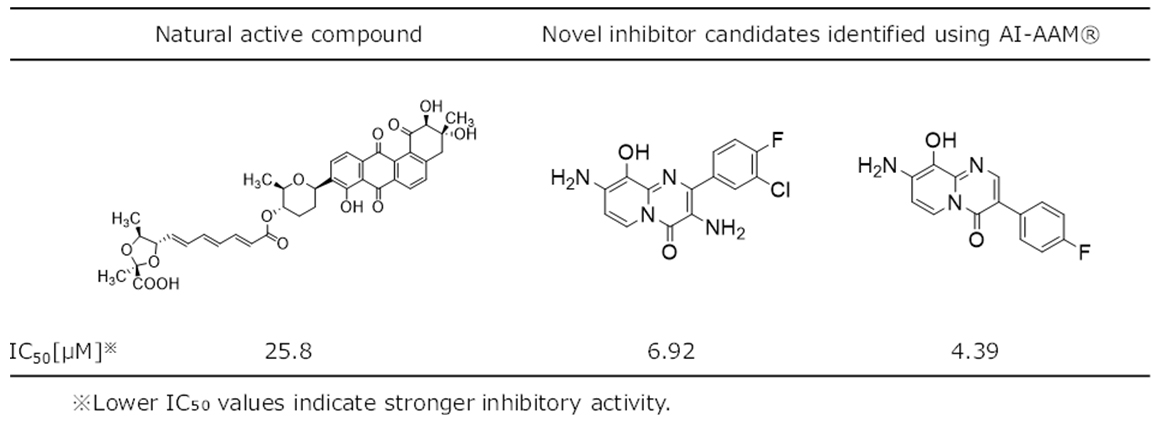
- Figure 1. Chemical structures of the natural active compound (left) and the novel inhibitor candidates discovered using AI-AAM® (right), together with their experimentally determined inhibitory activity values (IC50, μM). While the natural active compound has a complex chemical scaffold, the novel inhibitor candidate possesses a scaffold that is easier to synthesize chemically.
Fujifilm provides drug2drugs®, an AI-powered drug design service that leverages AI-AAM® as its core technology to support the identification and design of compounds with novel scaffolds starting from known active compounds. Going forward, Fujifilm will continue to utilize AI-AAM® and other proprietary technologies to improve the efficiency of drug discovery research and contribute to the creation of innovative new medicines.
- *1 A compound that binds to and acts on a disease-related protein (target protein).
- *2 Fujifilm’s proprietary AI technology that extracts structural requirements for chemical stability from vast numbers of compounds registered in chemical databases and designs entirely new compounds based on those requirements.
- *3 The fundamental framework formed by the connectivity of atoms within a molecule.
- *4 The process of designing and chemically synthesizing a variety of derivatives based on a given compound.
- *5 A compound obtained by chemically modifying part of the structure of a specific compound.
- Journal
The Journal of Antibiotics (Springer Nature)
- Article Title
Amino acid mapping–guided scaffold selection and hit identification of histidine kinase inhibitors from a virtual library of over 12 million compounds
- Publication Date
9:00 AM September 30, 2026 (Japan Time)
FUJIFILM Corporation
CRO Business Development Office
Email:dge-CRO-inq@fujifilm.com
- * Please note that the contents including the product availability, specification, prices and contacts in this website are current as of the date of the press announcement and may be subject to change without prior notice.