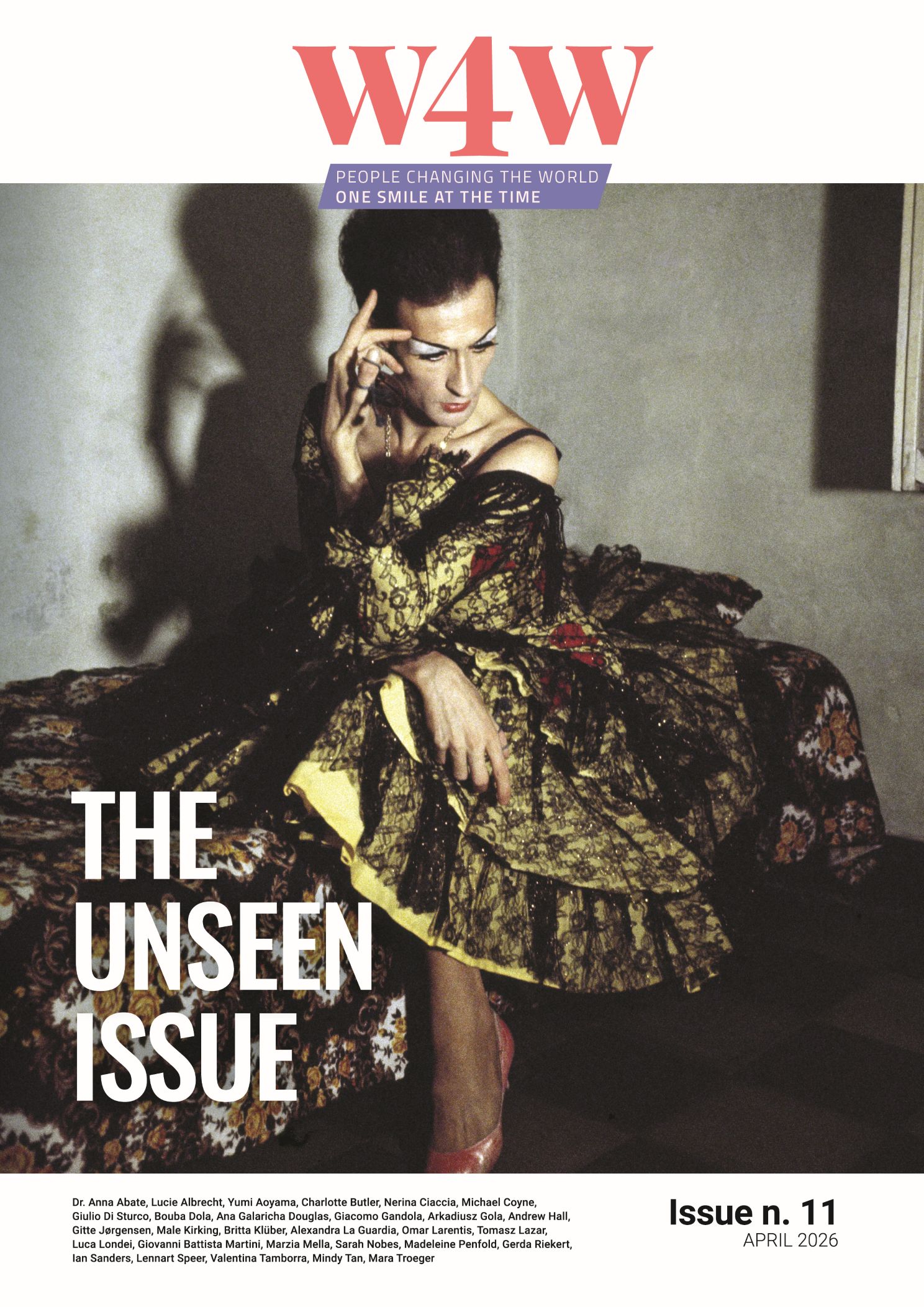






Women4Women renews itself starting from its name. W4W – The Unseen Issue, the eleventh issue of FUJIFILM’s magazine, is the realm of the invisible—of what the eye overlooks out of habit and what society superficially chooses to leave in the shadows. Enhancing it is a completely redesigned layout, conceived to give space and power to photography as a narrative capable of piercing the page.
The project also opens up to male contributors, creating a mosaic of voices that does not seek uniformity, but rather the universality of perspectives and opinions.
W4W confirms the breadth of its horizons as a constantly evolving concept with an international scope, aimed at being a space for reflection, dialogue, and listening on the crucial issues of our time. It is a global platform where photography becomes a vivid language, capable of conveying powerful and unconventional testimonies.
Across more than 180 pages, nearly 30 contributions from over 10 countries aim to make visible contexts and people too often pushed to the margins of society: reshaped human landscapes, silent forms of resistance, and an ethical commitment that is ever-present yet camouflaged. The invisible is a profound condition of both body and soul: it is the voicelessness of those fighting aggressive and silent illnesses; the quiet dedication of those supporting hidden humanity while remaining in the shadows; and the dignified courage of those living with a vulnerability that the world has yet to recognize.
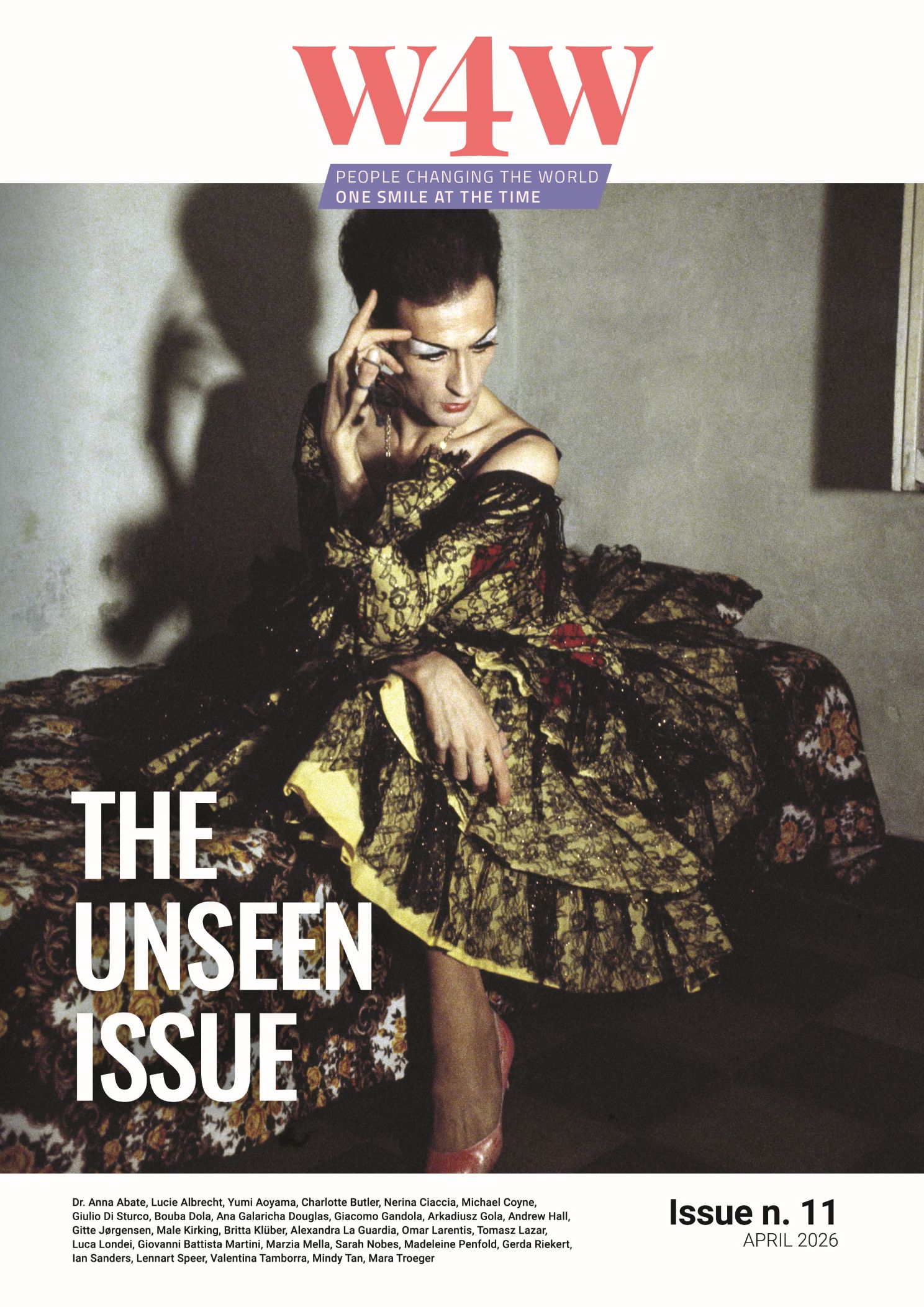
The cover itself is a statement: it features the work of Lisetta Carmi, a radical and independent figure in twentieth-century photography. The image comes from the renowned series I travestiti (1965–1971), a pioneering reportage on the transgender community in Genoa, created with respect, empathy, and deep ethical responsibility.
“The unseen is both a physical and emotional journey. The new issue of W4W – The Unseen Issue ventures where light struggles to reach: borderlands, forgotten geographies, and human stories left on the margins of the spotlight,” says Luana Porfido, European Head of Corporate Communication and ESG Management at FUJIFILM Europe GmbH. “We tell stories that happen ‘far from everyone,’ not because they lack value, but because they are too intense to be consumed by the rush of everyday life. Leaf through these pages with new eyes. Do not seek the reflection of what is already known but allow yourself to be guided toward the unseen. Because it is precisely there that the most authentic and memorable part of our humanity resides”.
One of the first powerful testimonies is that of Valentina Tamborra, an internationally renowned X-Photographer and Fujifilm ambassador. Hers is a photography of crossing, driven by an almost physical urgency to understand what lies beyond the main frame. This is evident in the project The Flowers Remain – Identity Surviving Torture, created in Palermo with Médecins Sans Frontières: a collective work with survivors of torture, focused not on pain, but on what pain has failed to destroy.
Giulio Di Sturco, an award-winning photographer and sensitive interpreter of contemporary transformations, presents Anthropocosmos, a visual research project that moves away from reportage toward philosophical reflection. The project stems from a desire to slow down the gaze, exploring places where the future is designed in silence: scientific research centers, technological laboratories, and space simulation environments. In these “thresholds” of human ambition, Di Sturco does not seek the spectacle of conquest, but rather the suspended atmosphere and emotional residue embedded in machines and architecture. Through photography that chooses to “withhold” rather than reveal, the author uses human absence as a narrative device, inviting viewers to reflect on the relationship between technological progress and ethical responsibility.
Polish photographer and artist Tomasz Lazar, a Fujifilm ambassador, presents two projects. With Voids Diary, developed during the Covid-19 pandemic, Lazar documented the stillness and emptiness that the health emergency imposed on places once defined by exchange and connection. By listening to what emerged from the void, he captured people’s inner silence and the emotional and psychological impact of the virus on society’s most marginalized groups. The inspiration for What Remains arose from the desire to document the traces of life left behind by the war in Ukraine—to bear witness to what remains when so much is destroyed, and to tell how people are forced to flee as communities collapse.
Photography as a tool to reveal what (apparently) is not there—or has been buried for years—is explored by Omar Larentis, coordinator of the Research Center in Osteoarchaeology and Paleopathology at the University of Insubria (Varese). With the project Under The Skin, funded by Fondazione Cariplo and promoted by Fondazione Comunitaria di Lodi, Larentis and Ilaria Gorini, professor of History of Medicine at the University of Insubria, investigated the extraordinary anatomical collection “Paolo Gorini,” consisting of around 200 petrified specimens. Thanks to FUJIFILM Healthcare Italia’s radiological equipment and laser scanning, they revealed the internal structure of the samples, the degree and depth of petrification, the presence of added materials, and the various stages of treatment. Radiology played a fundamental role, transforming the invisible into the visible—and then into knowledge.
Male Kirking, a breast cancer survivor and activist, recounts a silent yet determined resistance: diagnosed at 25, she had to fight against a society that was skeptical of her symptoms due to her young age. This dissonance—being young yet seriously ill—is also powerfully highlighted by Lucie Albrecht, Press and Public Relations Officer of the German Foundation for Young Adults with Cancer. The foundation supports young people aged 18 to 39 affected by cancer and serves as a reliable reference point for families, healthcare professionals, researchers, and policymakers.
Photography as an ethical and responsible commitment is expressed, among other ways, through the contribution of artist and photographer Mara Troeger, whose project Black isn’t Black sheds light on injustices often associated with Black individuals, and through the testimony of internationally renowned director and photographer Madeleine Penfold, whose This Girl Can campaign has helped combat the gender gap in sports participation.
THE EXHIBITION W4W WHERE THE UNSEEN BECOMES VISIBLE
Some of the projects featured in the W4W – The Unseen Issue will be exhibited from April 24 to 30, 2026, at the new Fujifilm X-DEN showroom in Düsseldorf (Altestadt 7, 40213), which opened last year and is used for workshops, meetings, and presentations.
The exhibition, titled Where the Unseen Becomes Visible, will be open to the public free of charge every day from 11:00 a.m. to 5:00 p.m. and will transform the creative hub for one week into a space for talks and conferences, exchanging ideas, and fostering dialogue among artists, the public, and industry professionals.
Click here to browse the new issue of W4W
👉 https://www.fujifilm.com/de/en/women4women#issue11.
Luana Porfido
European Head of Corporate Communication and ESG Management FUJIFILM Europe GmbH