











As the world shifts towards a more future-forward mindset, a growing number of businesses are turning to sustainable practices that extend beyond the usual eco-friendly labels. At Fujifilm, environmental conservation is at the core of our corporate vision. This commitment is reflected in our products, processes and solutions. We are driven to keep pushing the boundaries of technology to develop a circular economy, combat climate change and build a sustainable future.
The United Nations defined sustainability as “meeting the needs of the present without compromising the ability of future generations to meet their own needs”. In the context of businesses, it’s about first doing business responsibly and then pursuing opportunities to solve societal challenges through business innovation and collaboration. To reduce the negative impact of our communal actions on the earth and nurture healthier environments, human collectively need to develop more efficient, circular systems.
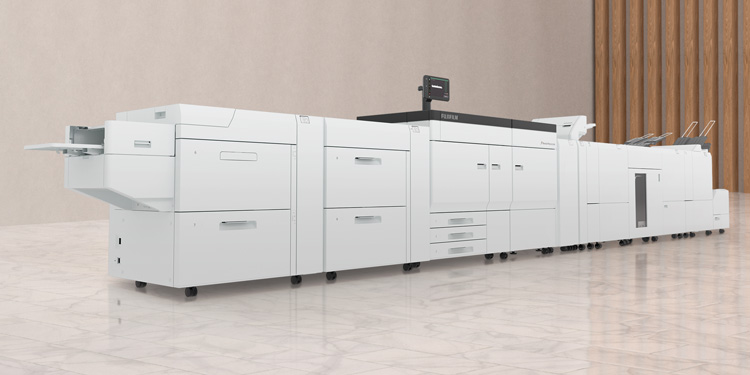
Companies can take the first step by making careful choices about daily-use office products such as printers. A seemingly small change can make a significant difference in the long term. Answering the call to make printers more energy efficient without compromising print image quality, we have developed continuously improved on our leading-edge toner technology.
Toner fusion is the most power-intensive process (accounts for 50-80% of total power consumed during print). Our toner enable a fusing temperature up to 450C lower than conventional toners which results in reducing overall power consumption significantly. Furthermore, our Super EA-Eco toner has one of the smallest toner particle sizes in the world enabling superior print quality.
Find out more about our toner technology here.
To conserve non-renewable resources and reduce carbon emissions, companies are thinking end-to-end. The challenge is to create a better and more effective product while also considering every stage of its lifecycle for a more circular economy. From design to material sourcing to responsible product disposal, businesses are exploring new ways to extend lifecycles of their products and materials in it.
As early as 1995, we became the first in the electric and electronic industry to present a product with reused parts. Soon after, we established recycling processes across our operations in the Asia-Pacific region. At our recycling sites, end-of-life products recovered from customers' sites are dismantled, cleansed, and screened for reuse potential or to undergo material recycling.
In addition, we have maintained programs that encourage our customers to return used toner cartridges and printers, so we can recycle and reuse them properly. This helps to close the loop and minimize impact to the environment.
Among the foremost objectives of sustainable design and environmental conservation is to protect our planet by addressing climate change. For most companies, this is an urgent call to identify existing environmental impacts in their production processes and to mitigate them while increasing their productivity. The end goal? A sustainable development.
As a company, we have launched a new Fujifilm environmental strategy, “Green Value Climate Strategy” towards the following:
- Manufacturing with a lower environmental impact (Green Value Manufacturing)
- Creation / promotion of products and services with excellent environmental performance (Green Value Products)
- Adopting business-specific targets in line with the new environmental strategy
- Introducing internal carbon pricing
Affirming our role and responsibility in the industry, Fujifilm continues to lead by example in the collective efforts to meet the 1.5 degrees Celsius target set in the Paris Agreement. Our resolve to provide and develop sustainable products and services in our ongoing efforts to foster a circular economy and reduce carbon emissions remains steadfast. Find out about our full environmental commitments Here
Contact FUJIFILM Business Innovation Sales Representative to learn more.