


![[icon] Healthcare IT](https://asset.fujifilm.com/www/ph/files/2024-08/3514d54d9d3ec87c1d2d11b1b153b5ef/healthcare-it.svg)
![[icon] X-ray](https://asset.fujifilm.com/www/ph/files/2024-08/056e99b23ae4ef386de613c4ac064366/x-ray.svg)
![[icon] Ultrasound](https://asset.fujifilm.com/www/ph/files/2024-08/a1fb3473ad4be3b722188042b9ea0327/ultrasound.svg)
![[icon] Endoscopy](https://asset.fujifilm.com/www/ph/files/2024-08/5df55cd8106f48ed373ad5eb87f6fef4/endoscopy.svg)
![[icon] In Vitro Diagnostics](https://asset.fujifilm.com/www/ph/files/2024-08/cad75b9b4e5222c67aca1467675a9c22/ivd.svg)
![[icon] Veterinary Medicine](https://asset.fujifilm.com/www/ph/files/2024-08/6262ac987c5c5902046fe478868423e9/veterinary.svg)
![[icon] MRI and CT](https://asset.fujifilm.com/www/ph/files/2024-08/2956136b3bba4933876acdef77ab3c74/mri-and-ct.svg)
![[icon] Inkjet Solutions](https://asset.fujifilm.com/www/ph/files/2024-08/4d3a176eb96c6fcef8f0711241b5734d/inkjet-solutions.svg)
![[icon] Office Solutions](https://asset.fujifilm.com/www/ph/files/2024-08/0144d6162a335bcacc4b157636b9dea9/office.svg)
![[icon] Semiconductor Materials](https://asset.fujifilm.com/www/ph/files/2024-08/44ce61d4f214147c615c6fb4293b9056/semconductor-materials.svg)
![[icon] Graphic Arts & Printing](https://asset.fujifilm.com/www/ph/files/2024-08/96970efe3cca442b60b2e83620779aa9/graphic.svg)
![[icon] Photofinishing Products](https://asset.fujifilm.com/www/ph/files/2024-08/47fcfcf87a6be4d8010c1e1ed17cf986/photofinishing.svg)
![[icon] Optical Devices](https://asset.fujifilm.com/www/ph/files/2024-08/eb4f6d2e0535092537a53677f01074c7/optical-devices.svg)
![[icon] Cine & Broadcast Products](https://asset.fujifilm.com/www/ph/files/2024-08/caf6dd77bd95bc3084b20ec1408e0975/film-and-broadcast.svg)
![[icon] Security Protections](https://asset.fujifilm.com/www/ph/files/2024-08/7ebd1ccf4b89dbd1d69c50f9ab035cc5/security.svg)
![[icon] Manufacturing Process](https://asset.fujifilm.com/www/ph/files/2024-08/4a5936f0395fd84173c41992b9c96631/manufacturing-process.svg)
![[icon] Inspectional Products](https://asset.fujifilm.com/www/ph/files/2024-08/14eb3dc93110b75b0eda973e00156f79/inspection.svg)
![[icon] Data Management](https://asset.fujifilm.com/www/ph/files/2024-08/6ca23267b96be62c7fbdf7fc95aa9fa3/data-management.svg)
![[icon] Materials](https://asset.fujifilm.com/www/ph/files/2024-08/cea9ba81bb1d9c0dac3b392aaa1351eb/materials.svg)


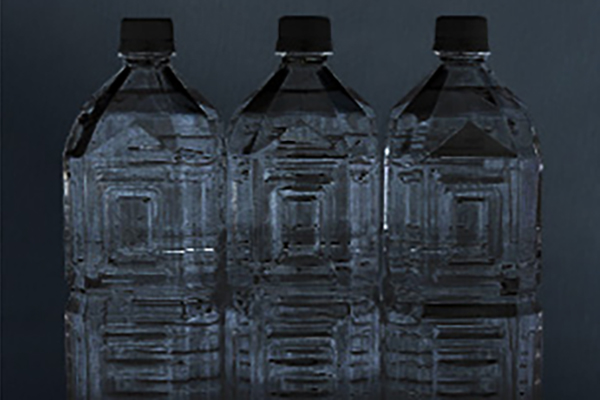
A beverage manufacturer, Company E, fills bottles with liquid, automatically inspects the height of the liquid level and whether or not foreign objects have been mixed in, and then ships the product. Since the inspection cannot be performed without reducing the diffuse reflection of visible light and allowing the plastic label to pass through, an IR light is used. When reviewing the automatic inspection system due to the expansion of the production line, they were considering ways to reduce costs.
- The IR-based automatic inspection system costs need to be reduced.
- IR lenses were more expensive than normal lenses.
- It was found that it was not necessary to use IR lenses if the IR transmittance of the lenses used was high.
- Costs were kept down by using machine vision lenses with high IR transmittance from FUJIFILM.
Company E is updating its automatic inspection system in line with the launch of new products and the addition of new flavors. As it is necessary to inspect the product by transmitting a plastic label, they were using an IR lens. In recent years, as part of their cost-cutting measures, they began to re-evaluate the relatively expensive IR lens.
Company E wanted to compare and consider a variety of lenses before making a choice, but there were only a limited number of lenses that support IR, and depending on the size of the sensor, there were cases where there were no options. Because there was no room for comparison and consideration, Company E had no choice but to go with an expensive lens.
The keys to solving these issues were...
"Suppressing lens costs” and "Discovering new options”
Company E, which wanted to keep the cost of IR lenses down, consulted with a lens sales agent with whom they had a business relationship, and was invited to attend a camera and lens-related exhibition. There, one of the camera manufacturers was demonstrating an IR inspection system using FUJIFILM's machine vision lenses, and when they checked the price, they found it to be very reasonable.
After the exhibition, Company E contacted FUJIFILM through a lens sales agent and consulted with them about their inspection content and installation environment. As they were only using a specific 850nm IR wavelength, FUJIFILM proposed the “CF25HA-1” machine vision lens, which has a high IR transmittance of over 70%. Company E decided to conduct a verification test immediately, as it was more affordable than the IR lens they had been using up until then. It was found that the resolution performance was also comparable to the IR lenses they had been using up until then, and they decided to install it. Company E, which uses multiple cameras to inspect the top, middle and bottom of the bottle, uses a large number of lenses, and the cost-effective CF-HA series was exactly the kind of lens they were looking for. The person in charge was very pleased, saying, “We were using multiple IR lenses, so we were able to reduce our initial costs by installing this lens.
There were few machine vision lenses on the market that were designed for IR. In the beverage, food, daily goods, and cosmetics industries, there are many cases where IR inspection is used, and there have been calls for more lens options. When using both visible and IR light, “IR lenses” are required, but in most cases, inspections are carried out using single-wavelength IR light, and in such cases, lenses with “high IR transmittance” can be used as a sufficient substitute, even if they do not support IR. FUJIFILM's machine vision lenses come in three types with high IR transmittance: the CF-HA series, HF-SA series, and HF-HA-1S series. The maximum sensor size that can be used is 1 inch (CF-HA series), which covers almost the entire range, so it can be matched to the current sensor size, and the range of lenses that can be selected is broadened. FUJIFILM will continue to focus on machine vision lenses, which are expected to be used in various fields, including environmental-related fields.
CF-HA/HF-SA/HF-HA-1S Series
CF-HA series, HF-SA series and HF-HA-1S series are machine vision lenses with high infrared transmittance. In addition to being reasonably priced and easy to use, the fact that they support 1-inch sensors (CF-HA series) also matches the automatic inspection system of Company E, and they decided to install them. The person in charge also gave us encouraging words, saying, “The lineup of FUJIFILM machine vision lenses is very helpful because it expands the range of lens selection. Please keep up the good work.”.
- * Not usable with systems that use both visible light and IR light.
- * Please contact us by the inquiry form for IR transmittance data of each model.
![[image] Graph of Spectral Transmittance](https://asset.fujifilm.com/www/ph/files/2025-08/94a42b798b5344b7a8347a04191af94e/fig_mvlens_02_1.jpg)
![[image] Usage example IR](https://asset.fujifilm.com/www/ph/files/2025-08/52afcee11c2c625bdd26b23cc635d73a/MV3.png)
![[image] Comparison of text with Single-wavelength 850-nm IR light source used](https://asset.fujifilm.com/www/ph/files/2025-08/bc17c7a6c6aa3c0266e48d4924eee0ea/fig_mvlens_04.png)